Showing posts with label athiesm/religion. Show all posts

Tuesday, 12 April 2011

Initial thoughts on philosophy of religion

I've been listening to an excellent lecture series on philosophy of religion recently by The Teaching Company. And it's got me thinking about how easy it would be to write a book entitled "bad ideas in philosophy of religion". But, here's some initial thoughts for words and phrases that shouldn't be used.

God

When I mentioned this the other day I was asked "what word would you say instead?" Which highlights exactly the point I dont want to make. The word God is as good as any other. The word itself it not a problem. The danger is when we use that one world to mean different things.

God has a fairly sensible meaning. "Something which is worthy of worship". Generally an omniscient, omni-etc being which created the universe. The problem is when people try to argue about a different meaning of God as though it were the same. Sometimes this is the "no true Scotsman" fallacy, sometimes it's just downright word-magic.

The classic example is people who argue that there is a Church of England God who wants us to go to church on a Sunday and use the book of common prayer by using the cosmological or ontological argument. Now, as it happens both of those arguments are nonsense, but for the sake of argument let us assume they work. What you have proved if so is that a being either "that which no greater can be conceived" in the ontological case or "the uncaused first cause of all". Neither of these ideas contain the slightest reference to the Book of Common Prayer. To argue as though they're the same is just plain wrong.

Metaphor

Language is complex. We often use terms non-literally or non-exactly. We talk about an electron "trying to get to the lowest energy level" knowing damn well that of course the electron hasn't got desires or anything of the kind. The important thing is that it's clear what the metaphor means. In this case that the electron will tend to occupy the lowest energy level it can consistent with the exclusion principle etc etc. If you cant unpack things in this way then there's no point saying it. It's not real communication, it's just you saying words. What's not acceptable, what's not meaningful communication is:

Careful now

"This book in my hand is the most perfect book in the world. It is a literal and perfectly true account of historical events. I base my beliefs and actions on the premise that the events contained in it are genuinely true."

"But this event mentioned here is clearly false."

"That's a metaphor."

To say that the book contains non-literal accounts is fine (so long as what those non-literal accounts mean is clear, which it isn't), but not if the literal accuracy of other parts of the book is something you rely on. Simply put, how do you know what's a metaphor and what's literal?

God is your father

Even given what I said about metaphor "God is your father" is a really bad example of the species. Because it gives a misleading idea of what the relationship between creator and created is. Same problem is implicit in the line "a smooth sea never made a skilled mariner". A loving father does need to be harsh so that his child can survive in the real world. Someone does need to expose a sailor to rough seas so they can survive in the real world.

But in no sense is this true of someone who creates the real world in question. A far better analogy, if we must use one, is to AI and programmer. The programmer can create the virtual world in which the AI is to live. There's nothing to limit what experiences this AI can have. So there's no compulsion on a loving programmer to expose the AI to harsh environments so it can survive in the "real world", there's no reason the AI ever needs to experience a scary world.

Proof

While I'm at it, see also the word certain, impossible etc. There are really really intelligent an well read theists, really really intelligent and well read atheists, really really intelligent and well read agnostics. So you can probably guess that at least someone has heard your argument, it's probably not as knock-down as you think it is. It's not a proof, it's just not.

Also while we're at it. A rather bizarre syllogism that people need to stop using. "You cant prove p" is not a proof that "not p", these are very very different statements.

Abraham

I know you live in the West. I know it's sometimes easier to just stick to what you know and have experience of. But seriously. The God of Abraham is not the only god.

(Btw, as I use it, there is a difference between God and god, a god is a type of thing, God is the name of one such example, God is another word for Yahweh).

This comes up a lot in Pascal's wager type discussions. God or not God is too simple. Which god? The question is how many gods are there and what are they like?

Ethics

Just a quick thing because this is something that offends me. Your religion and your holy book did not invent ethics. People do not need your religion to be moral. Please please dont be so arrogant as to think that you have unique access to moral truth. You just dont.

Saturday, 23 October 2010

A blog post from 2020

You may note the date of this blog post is in the future. I've done this because I want to talk about a universe that is different from this one in some respect but with the impression that, for all I know, this universe could become that one. My point is that I believe the universe I am about to present to be a consistent one, one which is not logically contradictory. This universe I dont think will come about, but if it did, I hope this is how I would react.

Sunday, 5 September 2010

Religion on twitter

The surprising thing about religion on twitter is just how unsurprising it is. If we take this very unscientific poll we see a lot of things we might expect. Firstly the raw data, all religions.


There are very few chunks that are very large, religious monopolies dont exist on the plural internet. The largest single one is atheist, unsurprising given that twitter is dominated by wealthy Europeans and Americans, and that the internet in general is great at getting atheists to gang up and crash polls of this kind. Another thing to notice is how far from negligible the small religions are, pagans account for whole 3%, wiccans another 2%. The raw data gives you an idea of how important this effect is, even the smallest group represented: Confucianists have 26 votes to their name.

So the raw data give us, dont ignore the little guys, there are atheists on the internet.


If we categorise religions however, we get another couple of ideas, again, not very suprising. The largest group is the broadly non-religious including agnostics, followed by the Christians, then the other Abrahamic religions, (note that this is 12% Islam and 2% Judaism), then the others, still an impressive 14%.

What can we work out from this? That the representation of Islam is a lot lower than you would expect from world totals, likewise the other major world religions besides Christianity. This is at least partially explained by this poll being run in English, ask the same question in Arabic or Hindi and I'll bet you'd get a different result. The rest might be explained by the penetration of the internet in various countries and social groups. Obviously there are far fewer Buddhists and Confucians than worldwide figures would make you expect because of the Chinese internet, likewise African folk religions.

One thing that might be interesting to note is how massively over-represented is the category "Other Christian". Roughly speaking the other categories are in the right proportions to eachother, but other is at least an order of magnitude too large. Is this tendency for people of all branches of Christianity to call themselves Christian even to put themselves into an "other" category something that is well known and studied? I can understand this result happening if there was a label "Christian", but the assumption of the poll is that you should select a denomination so people are actively rejecting such labels.

Friday, 3 September 2010

God and Stephen Hawking

It's not often that a story excites twitter so much it stays trending for more than a few hours. But the last 2 days solid "Stephen Hawking" has been stubbornly keeping to the top 5 or so terms used. I'd like to try and explain why and why he's right. Before I start though I'd like to add the disclaimer that everyone should use before discussing this: Stephen Hawking, comma, who is a fuck of a lot smarter than I am, comma, says:

God is not necessary to explain the universe.


Cue shocked noises ... or not. This is hardly news of course, "Je n'avais pas besoin de cette hypothèse-là"1 has been the maxim of a large number of (but very very far from all) scientists in the fully modern sense of the word. The difference is that Hawking has claimed this is the result of a genuine scientific result. I'd like to try and explain this result and what it means.

General relativity and energy

I'm not going to get too into the maths here, but in qualitative terms: We know from Einstein that gravity bends space. So a large object like the sun bends space into itself. thanks wikipedia This curvature has energy associated with it. Think of it like an elastic sheet, if you put something big on it it will bend, and this stores up energy. The important thing about gravity is that the energy you get is negative. Meaning that to get things beyond the pull of gravity you need to put energy in to get things very far away. So gravity can give us negative terms to cancel things out.

The big question is what this energy cancels out. Importantly we want to know if the total energy of the universe is positive, negative, or zero. Now there are a few factors to balance here. Firstly the energy in all the matter, that is the stuff, this has energy by E=mc2, to this you have to add dark matter and various other strange things. Secondly the energy associated with the universe expanding, we know that because of the big bang the universe is getting bigger, this moves objects apart, and so they gain gravitational potential energy. The last thing to work out is the total energy from all the small local bends, the curvature around all the stars and planets.

Luckily it turns out there's quite a simple way to add all this up. If the universe has positive or negative energy in total it will bend not just on the small scale but overall. If you walk around a hilly area you see lots of hills and valleys, but if you zoom out by going up in a helicopter you can see that overall there's no big change in the heights, there are never valleys somewhere that are higher than the hills somwhere else. But if you zoom out further, in a high plane or into space you can see that the whole earth is curved. It's bent right round on itself like a ball. This overall curvature is the big question. Because if there is an imbalance here then the whole universe will curve away like this. Only a universe where the negative gravitational energy exactly cancels with the positive energy from the matter is exactly flat, go as far as you like and things stay at the same level.

Now what Hawking has said, and he is right in this. Is that from what we can see with our telescopes, the universe looks really really flat. As far as we can tell it looks *exactly* flat.

A flat universe from nothing

This really matters for philosophers. Because there are big problems to be answered for any other kind of universe. We know that energy cannot be created or destroyed, but you can turn matter into energy, and vice versa, this is Einstein's E-mc2. This happens over and over again in high energy labs and in cosmic rays in space. Einstein says that if you have energy you can turn in into a much smaller amount of matter, and back again. So if you want to make a universe and fill it with stuff, you need a lot of energy to make it all. Now if this energy was more than gravity could make for you, then there's a big problem. Where did all this energy come from? We would need some kind of source of energy outside of the universe to make it. If the other way round there is too much energy from gravity and not enough stuff, then we have to ask where did all the energy go? Why has energy leaked out of the universe?

A flat universe is different. In a flat universe all the energy you need to make stuff is there because of gravity, nothing is created or destroyed. There is no violation of energy conservation. It is perfectly consistent with all known physics to say that the universe just make itself, from nothing.

nilio ex nilio

There is a high minded principle that a certain kind of philosopher loves very much. Nothing can come from nothing, things cannot be made from a vacuum. Such is the love of this idea that people say it in latin to make it sound like ancient wisdom. However, as with a lot of grand philosophical ideas, it's utter bullshit.

Stuff comes from nothing all the time. It's happening right now in every cubic millimetre of space in the entire universe. All over the universe right now and at all times particles are created and destroyed faster than you can imagine. This rush of particles and anti-particles popping into and out of existence is allowed and even demanded by physics. Particles come into existence in pairs that "cancel out" so that no energy is required to do this, so this means there's no violation of energy conservation and this happens so quickly and the particles so quickly pop back out of existence that the universe largely doesn't notice. This has been observed time and time again in laboratories and in cosmic rays from deep space. It's a fact, and you just have to deal with it no matter how much this ruins your grand philosophical notions.

So what Stephen Hawking has said is that there's nothing at all we know that stops the universe from just making itself from nothing. In fact, it's more or less demanded by the laws of physics as we understand it. So, he goes on. We do not need to suggest a creator, there is no requirement that gods be invoked to create everything, it was going to do it anyway.

Religion and physics

This is of course very very far from a proof that any gods do or do not exist. You cannot disprove gods using science, or at least, certain types of gods. Different gods are supposed to act in different ways, broadly we can think of a deistic type god, one which stays totally outside of the universe beyond creating it and makes no difference at all to the way things would be in the physical world if she wasn't there. You can say nothing at all about this type of god inside physics. However, there are other kinds of gods that do things, for instance perform miracles, create the world in seven days, heal people etc etc that can be tested. These gods are all (to the best of my knowledge) false, every rigorous test on a miracle that I know of has failed to show the predicted result. So many kinds of god can be disproved.

The question then is, has this result added any to the list of kinds of god that dont exist? Maybe. It's certainly placed limits on how gods could have made the universe, they cant have used any excess energy to do it, and they cant have done it in order to pump energy somewhere else. But really the significance of this is much like Darwin and evolution, it does not kill gods, it kills the necessity.

Before Darwin the watchmaker argument was really very strong. Atheists at this time really had to grit their teeth and say, "yeh, I know eyes look like cameras and people make cameras, but I'm sure there's some other explanation than gods". But after Darwin, this was no longer a matter of hope or faith, the mechanism was known, we didn't require as an explanation of the physical world to suppose any gods. If we didn't know this result Hawking is talking about, then would be a real question about how the energy got here or left, there's no known way for that non-zero total to have come about. Maybe gods would actually be a good explanation for such a universe. I dont think so, but that's largely a question of faith, not of science.

So ultimately I dont know if there is anything here for a religious person to be worried about. If it's an article of your faith that a god made the universe in order to pump excess energy into his home lighting grid then you may have to re-think that belief. But if not, if your idea of god or gods is consistent with a universe made from nothing then Hawking has said nothing that should worry you. Many people have an idea of a god or gods far beyond the reach of science, and such people shouldn't worry no matter how shouty the scientists get.

final thought

I was struck while thinking about this by just how consistent this is with some schools of Christian theology. A lot of people have argued that this result is impossible, you cannot have an uncaused cause, you cannot have something from nothing, life from non-life etc etc. But isn't that exactly what has been claimed by many thologians? The sentence "the universe simply is, it has no cause and needed nothing to make it exist, it made itself" may sound repellent, but replace "the universe" with "God" and you get good orthodox theology. God is the uncaused cause. Just call the universe God, and Hawking has just proved your religion.


Notes

1) "I had no need of that hypothesis." Pierre-Simon Laplace (1749 – 1827) once gave a book on physics to the very well read Napoleon. Napoleon is alleged to have asked why he had not mentioned God as the creator, Laplace gave this as response.

Wednesday, 11 August 2010

A nice proper rant.

Thankyou Ann Widdecombe. I've not had chance for a proper rant recently, so your article was a great help.


DON'T CONDEMN ALL DEBATE AS RELIGIOUS PROPAGANDA


Ok I wont.

Has anyone noticed that what the opponents of religion really want is that Christianity should be silent?


I would have thought opponents of religion would want far more than that, namely that all religions stop existing, not much point be an opponent of something if you're quite happy with it. But I'm sure you're going somewhere with this, carry on.


Last week it was reported that the British Humanist association has condemned an award given to Noah’s ark Zoo, a creationist centre near Bristol.


Quite accurate, I got a link to the article myself via their email newsletter.


The zoo has put on such an imaginative and educational display that the Council for Learning Outside the Classroom has issued it with a mark of recognition.


It is doubtless a fun place to go and one can learn a lot about modern animals, just as with any zoo. However:

Those who run the zoo have established workshops which cover the national science curriculum but do not include discussion of religion and do not promote the extreme creationist view that the world was created 6,000 years ago.


Here is a first problem. This is not an organisation which can be regarded as anything other than extreme. The clue is in the name. The Noah's Ark Zoo contends that Noah's Ark literally existed, all life is descended from a boat full of animals fully formed in their modern species. See several pages from their website. Admittedly they dont openly claim that the Earth is 6000 years old. An age for the earth is conspicuous by its absence. However their "sister website" does claim that the Cretaceous period lasted "around 4,000 years", this is like claiming the Empire state building is "around 2cm" tall, ok so you've not claimed the earth is 6000 years old, equivalent to it being half a millimetre tall, but it's still really very wrong.

In other words it is a moderate, education-focused organisation that challenges children’s minds and produces evidence from fossils.


Umm. No, not really. It's an organisation that promotes false science by pointing at misleading evidence including gaps in the fossil record that simply do not exist. Challenging children's mind on issues that are unclear or controversial is a great idea, it's important to make kids think about evolution in a critical way. But doing this with things that are simply empirically false is not critical thinking, it's just lies.


The British Humanist association says the award is inappropriate merely because the zoo concentrates on creation.


Yes. It's inappropriate for an award for education to be awarded to a religious organisation pushing a religious (and false) view of the world. Schools shouldn't go here anyway. If you want to go there yourself that's fine, if you want to take your kids that's fine, but you do not send school kids to a religious institution to be taught a false religious theory about the world using government money. That's not an extreme view, it's called church state separation and it's one of the most important ideas the enlightenment brought us.

In short the British Humanist association does not believe that children should be allowed even to discuss creation or to be exposed to any evidence that might support it.


Yeh. Creationism is a religion. It is not a fact. It is a purely empirical question and on a purely experimental observational basis it is false.


Also, academics carry out a study of the effects of prayer on the blind and deaf and finds evidence people’s sight and hearing have improved as a result of faith healing. Immediately the National secular society brands the findings “religious propaganda”.


Yeh, because if you're thinking of the study I am it's a load of crap. It's been Phyrangualted pretty well, but in short, the study shows that a small group of people who believed in the power of prayer and wanted to prove as much to others said that they felt better after being prayed for in a very dramatic and obvious way. In short this study proves only the stupidity of the people who designed it.


Its president Terry sanderson says faith healing groups “exploit the desperation of people living in extreme poverty who are unable to access proper medical care”.


For example those selling magic medicine to cure AIDs in sub-Saharan Africa.

Really, Mr sanderson? My mother lived comfortably and had available to her all the medical care the NHs could provide and her private insurance could buy and she still experienced miraculous healing.


Non sequitur. There is no contradiction between faith healing groups exploiting poor people and your rich mother experiencing a miracle. (One could argue there is a contradiction between receiving "all the medical care the NHs could provide and her private insurance could buy" and still calling the healing she got miraculous, but I digress).


Forbidding children to examine both sides of an argument is to substitute propaganda for education and dismissing as propaganda properly conducted surveys is a mark of intolerance.


I totally agree. So when there is a situation with two sides and valid arguments on both then children should be shown both sides. But that's not the case with evolution is it? It's not intolerant to say that when every sane intelligent person who examines something (including the majority of religious people in this country) concludes one thing, and people with an anti-scientific world view who deliberately falsify evidence and peddle lies to kids conclude another, that maybe there's no controversy. Teach the controversy, but not if it doesn't exist.

We can expect the British Humanists and the National secular association to be pretty vocal during the Papal visit.


Damn right people are going to be vocal when the head of an anti-gay, anti-women, anti-science, anti-medicine, anti-choice, anti-freedom, anti-everything-that's-bright-and-happy-in-the-world organisation comes to the UK at taxpayer's expense. Damn right there's going to be protests against the head of an organisation that has covered up rape on an industrial scale. Damn right there's going to be protests against a bigot who speaks against the equalities bill not, as many (myself included) did, because its approach was heavy handed and unworkable, but because he is genuinely opposed to equality. Damn right we're going to protest, the man is a bigot.

It is as well therefore to understand their bigoted approach from the outset.


Umm, no. Intolerance and bigotry means an irrational rejection of an idea and a demand that it shut up. Seeing that demonstrably evil groups (the Catholic Church) are attempting to spend taxpayers money and campaigning against that is not bigotry. Seeing that organisations that wish to lie to children about empirical facts (Noah's Ark Zoo) are recommended as a place for school trips and campaigning against that isn't bigotry. Seeing that academics wish to present the kind of stuff that would be thrown out of a year 9 science fair as novel research and telling them they need to seriously consider a new career isn't bigotry. And writing this article for the Daily Express isn't bigotry either, it's just stupidity.

Tuesday, 20 July 2010

Scientology is a cult.

Scientology is a cult. I'd like to work out why it is that this is considered to be defamatory. Scientology as the organisation responsible for a set of beliefs about the afterlife and spirituality 1. They are often and accurately described as a cult.

I think it's fair to describe them as a cult and not as a religion as they are really quite small. Small in this sense means a few things. Firstly membership, there are tens of thousands of Sceientologists2 compared to millions of even the smallest religions, (there are estimated to be almost 1 million Wiccans). Secondly this is a set of beliefs that is very young, L. Ron Hubbard made it up in 1952, compared to Islam, a very young religion at a merger 1400 years old. There's another factor too, it's a question of clubs. Micronations like Sealand or the Kingdom of Lovely are micronations because they are small, but also and more importantly, because real countries say they are. There are dozens of self-declared micronations out there that are larger in land and in population than Vatican City. Nationhood is about being a member of a club (in practice, of the UN) likewise being a religion means being respected as such and being invited to interfaith talks. (This is one possible argument why we could choose to not call atheism a religion). To me this is what we mean when we say a cult, we are thinking of a small, young, unaccepted religious group

So, I think it's fair to say that Scientology is a cult. But Sceientologists dont. Many have claimed that this is defamatory, and the word cult is derogatory in not uncertain terms. I want to work out why. The word cult is used about many strange and dangerous groups, the Jonestown Cult killed 400 of its own members, the branch Davidian cult fought a pitched battle with the American military during which 80 were killed. This image of the cult as having strange beliefs and an unhelpful obsession with violence etc is interesting. Because we know well that violence of the kind mentioned above is not unique or even more common in smaller faith groups, we also know that strange beliefs are not unique to such groups. (Look at it from an outsider's perspective, is it really more implausible that a galactic dictator brought billions of his people to volcanoes on earth and destroyed them with hydrogen bombs that that there are people alive who can cast a spell and literaly turn bread into the flesh of a 2000 year old dead jew).

So then if we can expect a cult to have violent elements and strange beliefs in ways similar to established religions, why is cult derogatory. There is a question of the club aspect of religions, many religious people (whilst clearly not agreeing with them) will respect the religion of another, but not of a cult member. I think there is an impression that cult beliefs are not very serious things. We dont think that anyone in their right mind can accept the beliefs of a cult. Tom Cruise is an international joke for being stupid enough to be part of a cult, often mocked by people whose own religion (if interpreted as literally as most interpret Scientology) contains elements just as foolish. Now, I must be clear that I dont want to dismiss thousands of years over very good theology by many of the greatest minds produced by humanity in explaining the strange beliefs in religions to make them more reasonable. There are great systems of thought around the great religions that are far more impressive intellectual achievements than the science fiction written by one guy that makes up Scientology's corpus. But is is fair for me to say that the beliefs of the average belier are made better by a more impressive theology? No, theology is not religion. Most religious people do not accept the version of religion presented by theology.

Is there a case for talking about liberal verses orthodox? For example, most Christians (in the UK at least) dont accept transubstantiation to be literally true (many do of course). But we expect that all Scientologist accept the Xenu story to be literally true. This is of course utterly false, for a start, the Xenu story is not told to the lower ranks at all, only the high level Tetans are expected to believe this, and how many of them believe it to be literally true and how many a good metaphor we cannot know. It's also important to consider how much the dogmas matter in a cult (matter of course to an outsider as we are considering defamation), it is assumed that pointing out how utterly insane one would have to be to believe in Xenu is enough to dismiss Scientology, if we do the same with transubstantiation then we are swiftly told "that's not the point". We think that ethics, or a relationship with God, or a sense of community are the key aspects of a religion, cults are often dismissed by pointing out that they hold insane doctrines.

There may well be a case that cult is simply a derogatory term because it contains all the negative qualities of religion without the implied respect for belief. After all, religions have a long track record of good deeds that we should (I mean this genuinely) respect and admire and it is assumed that cults do not. Religions help people out in times of trouble, and it is assumed that the beliefs of a cult cannot do this. Religions also present a strong tie to a community with shared heritage, this is not to say of course that cults cannot link us to a community, but the link to cultural heritage does not exist in a cult.

Scientology is a cult. We think this is a bad thing because the word cult presents a religion with all the stupidity and evil implied by religion but which we assume cannot have the redeeming qualities that religions have. I'm not sure the word really deserves the defamatory sting it has acquired. There are many cults (like Scientology) that are dangerous and evil, but the fact that they are cults does not imply this any more than is implied by being part of a religion.


1) What that word means is utterly beyond me, can anyone help? I've never seen a definition that wasn't “stuff that's ultimate or beyond reality”, well, like what for instance?


2) This is disputed by Scientologist who claim there are anything up to 10 million of them, but if so they're very reluctant to say so in surveys of religious belief and on the census.

Thursday, 20 May 2010

Everyone Draw Mohammed Day

STOP. If you are offended by the idea that people might draw Mohammed (or even refer to him without putting PBUH at the end) then stop reading. This isn't going to end well for you.

Are they gone? Good.


I'm going to draw Mohammed today, because today is officially "Everyone Draw Mohammed Day", it's on facebook, it must be real. This post is going to be me explaining why I think it's not immoral for me to do this, and also why I think it is good that I'm doing this.

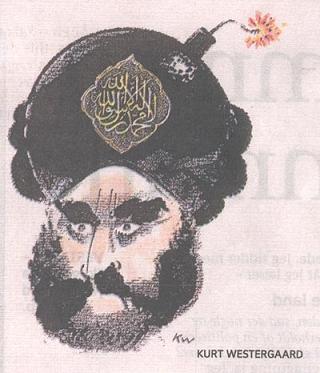
First reason, banning. People are trying, by force, to stop other people communicating ideas. Take away all context and that's the situation we are in today. When Theo van Gogh was shot 8 times for making a film critical of women's rights under Islam that was an attempt to silence opinions that his murderer did not agree with. This can never be acceptable. There is no opinion so vile, so evil, so hate filled, that it could ever amount to an evil equivalent to murder. The general argument against censorship is laid out in On Liberty far more clearly than I could ever do here. In shot, consider two cases, either the opinion we censor is wrong, in which case we deprive ourselves of the ability to strengthen our own views by providing counterarguments or it is right, in which case we have deprived ourselves of the truth, which must harm ourselves. I have always argued that the only possible moral response to violent censorship is resistance. If those who want to use violence to censor cannot be convinced they are making a moral error, they must at least be convinced that their aim is impractical, and the internet is wonderful for this. Thanks to the Streisand effect anything that someone tries to censor can (with a little help from obsessives like me) spread far faster than it would have had the censorship not taken place.

The image of Mohammed that sparked off the Danish Cartoon Controversy of 2005 The image of Mohammed that sparked off the Danish Cartoon Controversy of 2005, before the controversy, not many read and fewer cared about this cartoon, now it's the first image result on google.

Second reason, sacred. Muhammed is different from the Chinese government censoring the BBC or celebrities censoring something critical of them. Muhammed is sacred. And I think the concept of sacredness is one of the most profoundly dangerous concepts the human mind is capable of expressing. The idea is that Muhammed is somehow beyond considerations of right and wrong, that attacking, or even appearing to attack, him in any way is a grave offence. He has acquired this status because his religion won. Nobody considers banning criticism of the cult of Scientology, because that religion is so small everyone still calls it a cult. Islam is too big for that, that's why legislation has been put before governments all over the world and in front of the UN to prevent any criticism of Islam. Do we think that it is right for questions about what opinions are acceptable to be decided by who has the biggest fan club? If so then I have to ask you if you are aware of the history of early innovators of science and early adopters of religions. If we think it is right that Muhammed should not be criticised because he is sacred then we should agree that the early Christians should have been persecuted for their heresy, that Muhammad should have been persecuted for his, etc etc.

An early Renaissance fresco depicting Mohammed being tortured in Hell. In 2002, Islamic extremists plotted to blow up the church in order to destroy the image. An early Renaissance fresco depicting Mohammed being tortured in Hell. In 2002, Islamic extremists plotted to blow up the church in order to destroy the image.

Third reason, theology. Muhammad has an interesting place in Islamic theology, rather like the role Mary has in Catholicism. He is not a god and not worshipped, but he regarded with a huge amount of respect and reverence. The reason for this is simple, at least for the Shia. He was without sin. He, and his relatives, were protected from all sin. This forms 3 parts, firstly, he received the Koran from Allah without error, next, he transmitted it without error and finally, he lived without error. Many Muslims quite deliberately seek to emulate Muhammad in their actions because they believe he was without sin. A lot of people criticise Muhammad for marrying Aisha at age 6 and having sex with her aged 9, this is attacked as a lack of understanding of his cultural circumstances. That is precisely the point I would like to make. We all see now that this action was unacceptable (if you dont see that, really, go away and have a think about your morality) the fact that he and those around him didn't see it them indicates that there has been moral progress in humanity from his day to ours. To claim then that Muhammad was moral is either to claim that this moral progress has in fact been a decay, that having sex with 9 year olds is fine, or to suggest that there is no framework for morals at all beyond one's own culture. In either case, I really dont want people in this day and age imitating Muhammad in everything he did. A fine teacher he was, wrote some very nice poetry, but a relevant moral guide for all aspects of modern life? Give me a break. To respect this man as a poet or a leader of men is one thing. To demand respect for him as a paradigm of morality is quite another.

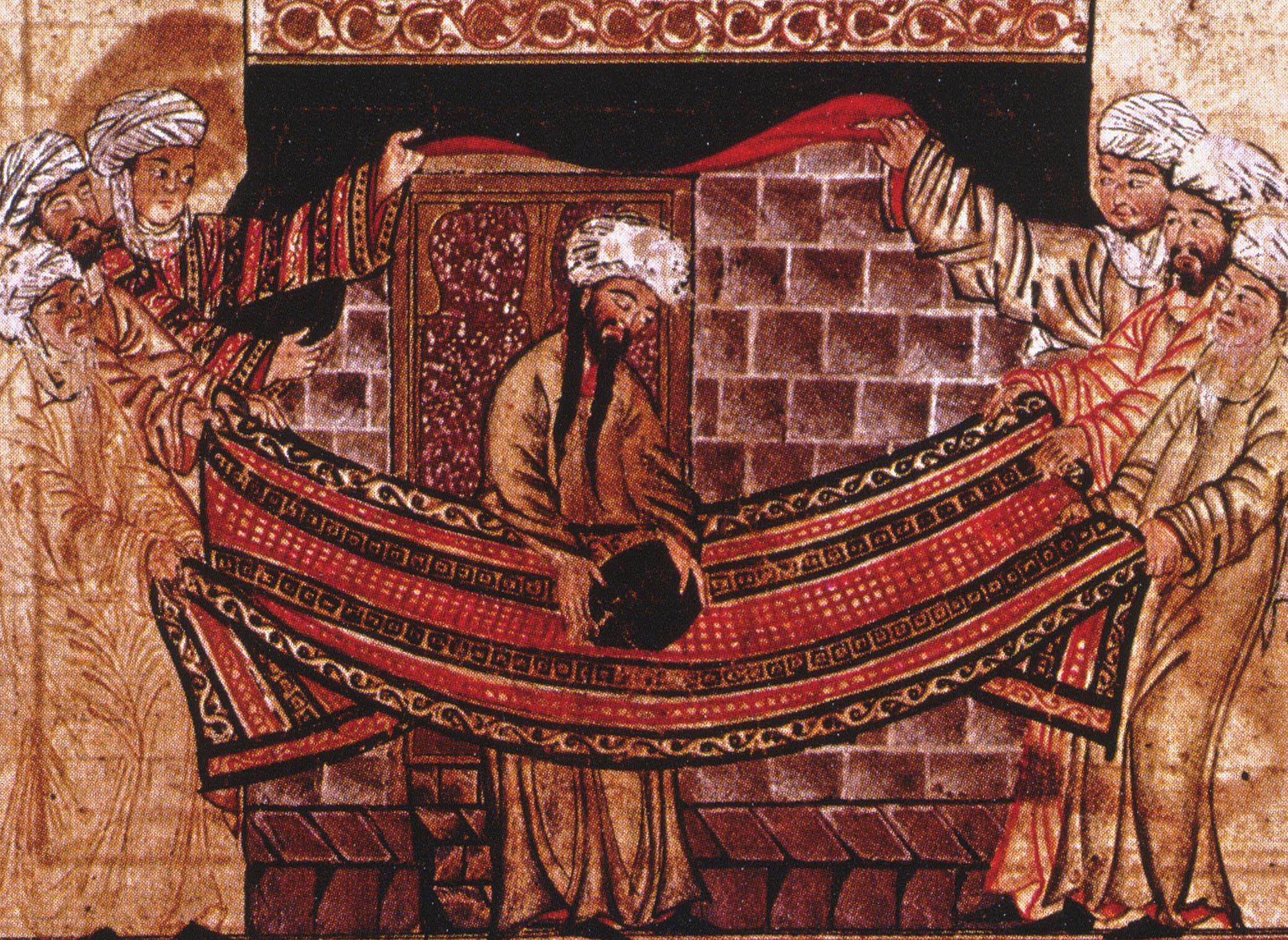
The Islamic prophet Muhammad solves a dispute over lifting the black stone into position at al-Kaaba c.1315"The Islamic prophet Muhammad solves a dispute over lifting the black stone into position at al-Kaaba" c.1315

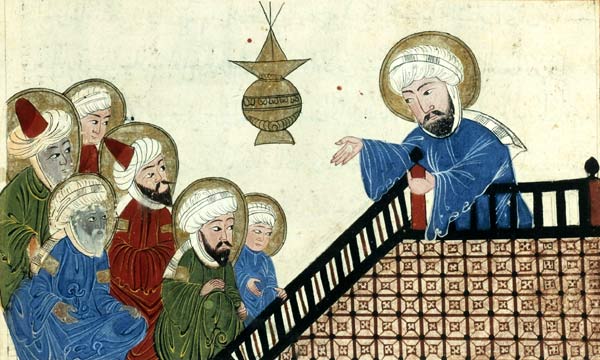
Fourth reason, history. Muhammad is a character in history, just like Napoleon or Isambard Kingdom Brunel. He was born, lived, walked around, went for a poo, died, and did all the other things that people do. He was a profoundly significant historical figure. Under his influence Arabia was transformed beyond recognition. Without him western civilisation would have taken a profoundly different course. To try and put one of the most significant men in history into a bubble and claim that discussion of him is impossible or somehow off limits is mad. Specifically on illustrations, the idea that one cannot draw Muhammad is a relatively new one (in practice at least). Early images of Muhammad are not uncommon. For example:

The Prophet Muhammad, 17th century Ottoman copy of an early 14th century (Ilkhanate period) manuscript of Northwestern Iran or northern Iraq (the The Prophet Muhammad, 17th century Ottoman copy of an early 14th century (Ilkhanate period) manuscript of Northwestern Iran or northern Iraq (the "Edinburgh codex").

Fifth reason, religious freedom. I believe in religious freedom, I think freedom of religion is one of the most important rights people can demand for themselves. This means every religion must be free to sink or swim according to how well it can argue and persuade others that it is correct. If any one religion (or religion as a concept over irreligion, or vice versa) tries to claim privilege over others then the freedom of conscience and thought of all others has been infringed. When the Racial and Religious Hatred Bill was being debated the strongest voices of opposition were from the religious community. The problem is there is no respectful way to talk to someone of another religion without deliberately being disingenuous. There is no way to express the idea "I believe that your fundamental assumptions about the universe are false" without being disrespectful or insulting. I'm damned sure there's no way to express the idea "the creator of the entire universe is so displeased by your religious beliefs that after you die he will punish you for all eternity" respectfully. If we are going to allow religions to be free, and I believe it is vital that we do, then we must allow that they be criticised, even if doing so is offensive. Some historic drawings of Muhammad are cartoons designed to attack Islam in favour of Christianity, I think it important that the rights of Christians (and others) in this be respected.

This illustration is taken from La vie de Mahomet, by M. Prideaux, published in 1699. It shows Mohammed holding a sword and a crescent while trampling on a globe, a cross, and the Ten CommandmentsThis illustration is taken from La vie de Mahomet, by M. Prideaux, published in 1699. It shows Mohammed holding a sword and a crescent while trampling on a globe, a cross, and the Ten Commandments.

Sixth reason, bloodymindedness. I have a fantastically contrary bent, it'll annoy people and this causes me a great deal of pleasure. ... No it's not a very profound argument, but it works for me.

Saturday, 1 May 2010

Atheism and agnosticism.

A lot is talked about atheism and agnosticism, many claim that agnosticism is superior because it's more open minded, others that agnostics are just fence sitters who need to make a decision. I'd like to weigh in. I am an atheist. But I am also agnostic, I dont think these are incompatible, but I never describe myself as agnostic when asked for a religion. I'd like to explain what I mean by this with help of a small diversion.

I dont care about metaphysics. Metaphysics is the study of those things which can be said to exist beyond and outside of the physical reality we experience through the senses, memory, feeling of consciousness etc. I dont think debates on metaphysical questions can be productive, primarily because there is no way to present evidence or arguments about things we cannot experience in any way. I'm not interested in arguments about the idea “gods exist” if those gods cant be observed. There's no way to know anything about such beings, so any debates about them cannot conclude. This is not to say I dont have metaphysical opinions, I'm a mathematical Platonist, I believe that abstract mathematical ideas like the number 7 or triangles can be said to have some kind of existence beyond any particular collection of 7 things or any drawing of a triangle. I dont try and argue with people about this, because I dont think that belief is meaningful. It's a reflection of my own emotional response to mathematics, there no argument I can give to show I'm correct, or evidence I can show.

That aside, let me turn to gods. I am an atheist about metaphysical gods. The existence of a god beyond this world doesn't fit with my emotional response to the world. This is not an argument, if you do believe in such a god, I dont think we disagree. I dont think there's a real difference between a world with a purely metaphysical god and one without. I dont care to change that belief, I dont care for arguments trying to change what I think. I have many friends who believe in such a god, and I dont think there's anything they believe that I could sensibly argue was wrong. I am agnostic about such gods, because I dont think there is anything here about which one can have knowledge (a-gnostic: without knowledge). I am agnostic in the 50:50, have no basis for a decision one way or the other sense. To say I am closed minded about this misunderstands, I dont think I know the right answer, I think there is not a right answer to know.

However. There is another sense of the word god, another sense of agnostic, another sense of atheism. Interventionist gods are beings which affect the physical world. Specifically they change the world in a way that shows that they care about life (generally, humans in particular). I've deliberately defined this in a rather broad way. Under this heading I include immensely powerful but totally physical beings like Lovecraft's Cuthulu or the Doctor, along with beings that exist outside of space and time, but which occasionally reach in a change things, the Greek pantheon as a classic example, a final thing of this kind is the cosmic watchmaker, a being who creates the universe, sets all the laws of physics in place with the aim in mind that life should grow and develop. I think this is a being whose existence can be argued about, there is evidence that could show this being to exist or not. There are many people who believe in one kind of god and not the other, there are deists who believe there is a god but that it has no influence on the world, there are people who belive in a god, but an entirely physical one.

About this second kind of god I am an atheist. I think that a universe designed with life in mind would not look like this. It wouldn't be mostly empty and useless to life. It wouldn't be almost guaranteed to kill any lifeforms that left the safety of a planet. And there would be far more planets that could support life. I think a universe designed with life in mind wouldn't end (as this universe will) with all matter falling into a vast number of black holes and ending up cold dead and empty. I dont think that a universe where gods influenced the outcome of wars would really have a history like ours. I dont think a universe where illness was caused by the vengeance of angry gods would have such perfect correlation between public heath and pandemics. I dont think, in short, that this looks like a universe that anyone cares about apart from us humans.

However. About such gods I am also agnostic. I dont think that I have an absolute truth, I dont think I can prove my belief like I can prove Pythagoras' Theorem. If there was some way in which I was convinced that either such a god existed or Pythagoras' Theorem was false I would be obliged to accept such a god. I am not closed minded about this, I have however made my mind up. These are not incompatible, it is possible to hold a belief without being mathematically certain of it. After all, I believe quite strongly I am sitting on a chair, but, I'm not looking at it, it could well be that someone broke into my room as I was sitting down and replaced it with a carefully posed flamingo. If I stand up and look at this flamingo I'm not going to steadfastly believe that it is in fact a chair, but that doesn't mean I'm going to keep checking it to make sure.

There are two senses of agnostic, either claiming no knowledge or even strong belief can ever be justified in any way, or to claim that you cant be perfectly mathematically certain beyond any possible doubt. Both are valid in their own domain. To claim the first kind refers to physical facts is nonsense, evidence about the physical world exists in vast and fantastic abundance, we can know lots about the physical world with 99% certainty. To claim that we cant be perfectly mathematically certain about metaphysics is true, but not nearly strong enough to express our profound ignorance of anything beyond the physical. And like almost all atheists who have ever existed, I'm an agnostic in the sense each god demands.

I am then an agnostic, but I never describe myself as an agnostic, why? Because I take agnostic as read. I take it as a given that we can know nothing at all or have any evidence about metaphysics. I take it as a given that no physical theory will ever be 100% perfect, that we can never have perfect knowledge of the physical world. I take this as a given in everything, so I dont feel that saying it makes a contribution. If someone asks me who the Prime Minister is it doesn't help me or them to say that I cant be 100% sure that I haven't just misheard every time someone mentioned Gordon Brown. It helps them to say that it's Gordon Brown, we can take the 0.0001% uncertainty in this statement as read. Likewise, if someone asks me if I believe that 1400 years ago a man road up heaven on a winged horse I say no, I'm an atheist, the fact that there is a minute possibility of a horse with a fantastically rare mutation having ridden a man up to the sky can be taken as a given and doesn't help.

Saturday, 24 April 2010

South park

For those who've not followed this story: South Park made a childish and offensive cartoon depicting Mohammed dressed as a bear. Many Muslims were understandably hurt and complained. The response from one small Islamist sect was to threaten the creators with murder.

I dont like South Park. The animation is offensively bad, the jokes are childish, the philosophy is that of a 7 year old who's pretending to be an angsty teen. Before this became an issue I would have watched the show (with great trepidation) and said it was awful and shouldn't have been aired. I would have said there was nothing interesting being said, it was just offence for its own sake.

The treats changed that. Now the situation is very different. Someone has threatened another person with violence over an act of free speech. A human being has been threatened with death over some children's cartoons. This is not something any society can tolerate. A free society wouldn't like South Park, but it would tolerate it. A free society can never tolerate immoral acts, and threats of murder and acts of violence are just that.

So these threats have changed my view. Before I would have thought that these cartoons should be quietly withdrawn by the creator of their own free will because of taste. I still think they shouldn't show it again, it needs to be replaced. It needs to be replaced with something much much more offensive. They need to make an entire show dedicated to desecrating Mohammed, show him as a cross dresser, child molester, show him being pelted with shoes, show him falling into a vat of excrement. I dont care what, just make the most disgusting, puerile, deeply offensive thing you can.

Because we, citizens of liberal democracies, need to show the world something. We need to show that we think free speech is more important than offence. We need to show that we cannot be threatened into silence by anyone. We need to show that nobody can threaten another's life and expect them to just back down. We need to show that our values are more important than their prophet. And they are, dont let yourself think that your principles, how you run your society, what you stand for as a citizen of a free country, can ever be less important than someone else's idol, be it a man, a book, a statue or anything.

We need to fight aggressively against any attempt to create or protect taboos. Nothing can be sacred, because if you let one thing become sacred and unspeakable, then it will grow, it will gain more territory of thought, block off more ideas, until it takes over. We need to fight those who threaten us, not with violence, we're better than that. We need to fight them with children's cartoons of a man dressed as a bear.

Saturday, 23 January 2010

The Atheist Bus Campaign

It's been over a year now since the first adverts apeared on London Buses sporting the message "there's probably no god, now stop worrying and enjoy your life". This caused a lot of fuss in the press, a lot of complaints, lawsuits, people refusing to get on buses and counter-adverts. After time has passed, I'd love to get a feel for how people react to this campaign. So I've gathered together some links with basic info to refresh your memory and I'd like to welcome general thoughts. Some questions for everyone to mull:

  • Did you ever see one of these adverts in the flesh? How did it make you feel if you did?
  • What do you think of the message, is a valid point being made?
  • This campaign was sparked by religious adverts linking to a website promising hellfire and damnation, do you think such adverts are appropriate?
  • A number of counter adverts were started including one reading "the fool hath said in his heart there is no god", did you see any of these? How did they make you feel?
  • The bulk of the money raised to pay for these adverts was raised by donations (full disclosure - including mine) why do you think people donated to this cause? Were they right to do so?
  • A number of posters were also placed on the Underground featuring quotes from famous atheists, are these better or worse than the bus advert?
  • More generally, what is the proper place for religion in public? Are religious adverts (including atheist adverts) appropriate?
  • The website linked to on the advert. http://www.humanism.org.uk "promotes Humanism, campaigns for an open society and a secular state, and works with others of different beliefs for the common good." Do you think such a website from a humanist perspective is worthwhile? Do you think there is a need for it?
  • Paul Woolley, the director of Christian think tank Theos, and a close associate of the Archbishop of Canterbury, has donated £50 as he thinks the campaign is a "great way to get people thinking about God. The posters will encourage people to consider the most important question we will ever face in our lives." Do you think this is a sensible attitude? Tactically do you think this is a good move for him?
Some background:

Friday, 22 January 2010

Different kinds of atheism, different kinds of supernatural

An argument that I hear a lot runs something like this. In some discussion of religion our atheist (boo) keeps on talking about how they can disprove religion with science, because evolution. The response is that religion nowadays has done away with creationism, that religion is about your relationship with god and faith. I'd like to suggest this is not so much a bad argument on both sides as it is a category error. The problem I have is that I as an atheist and my many liberal religious friends disagree on almost nothing religious bar the central question of the existence of god, thus whatever category of things it is that I oppose as an atheist, these people cannot be a part of it.

I saw a talk advertised today “1+1=3, Is a belief in God a denial of logic?”. The answer to which is of course not. No God that has ever been imagined is logicically impossible, if you claim that god is a 4 sided triangle, then yes a belief in god is a denial of logic, but few people do believe that. The interesting question is “The universe is 6000 years old, Is a belief in god a denial of observation?” This I suggest is worthy of some discussion. I believe that the statement “god exists” is false whatever kind of god you talk about, so I'll make it clear now I'm not speaking impartially on this, anyone of any belief or non who wants to nit pick or disagree please feel free. But I'll need some preliminary ideas:

Putting words together in order is not the same as communicating, the famous example is “colourless green ideas sleep furiously”. This is a grammatically valid collection of English words, but what is the point of saying it, you're not conveying information to me or influencing my emotions. Statements need to mean something. We can distinguish a few sorts of sentences, firstly pleasantries and exclamations that dont convey information but which make us feel happier, then questions, commands, statements about ourselves and our emotions, and statements about the world around us. These last two are the ones I'm interested in here. Subjective statements are statements about your own internal world, your likes/dislikes, your emotions, beliefs etc. Objective statements are to do with physical observation, what can be verified independently. So “this car is red” is objective, “this car is very ugly” is subjective, “I go to church on a Sunday” is objective, “I believe in god” is subjective.

So let's think about what it is that various people believe and what atheists are opposed to. Firstly let's consider why the belief “condoms cause AIDS because the pope says so” is dangerous. This is an objective statement that can be verified by experiment, give 1000 people condoms and ban 1000 people from having them and see who gets AIDS. Or even more simply, observe that HIV causes AIDS, that HIV is transmitted sexually in a way condoms prevent and observe that couples using condoms do not have substantially different levels of sexual activity compared to those who do. So, it's a false statement, but so what, people believe false stuff all the time, every time I watch QI I discover yet another false belief I hold. The problem with this belief is that it cannot be repaired, none of the observations listed above would convince the believer he was wrong. The reason this is dangerous and immoral is that he will then base actions on it. He will campaign to have condoms banned and reduce access to general sexual heath information and services. Here we have an objective belief that is false and irrefutable.

There is a rich history of theologians working to ensure that belief in god and in science are compatible. Most liberal religious people believe that the theory of evolution describes the real world more accurately than the two creation accounts in the book of Genesis. Most believe that the bible gives moral teachings but is not a textbook. These people stress faith and love of god as more important than beliefs in supernatural events. Some people take this as far as Karen Armstrong who says quite clearly that god does not exist. She means that god is beyond the material and cant be said to be the sort of thing that exists or otherwise.

There is a distinction to be made between various gods, or rather two broad categories of ideas of gods. Let's say an interventionist god is one who actively shapes the universe for the benefit of the humans he loves, he designed all the creatures and made the world to be a nice hospitable place for us to live. This god is talked about by reference to objects in the universe that can be observed, this god is objective. A spiritual god on the other hand is one who does not influence the universe (perhaps he started it going but that's beyond observation anyway), but who exists in some other sense. Whatever this other sense of existence may mean any talk of him is not talk of an observation, it is some sort of internal feeling. This god is subjective.

I'd like to think through the implications of various gods. If you believe in an objective god, then your belief can rightly be thought of as a scientific hypothesis. This is what the Discovery Institute in the states contend anyway. They claim that their evidence for Intelligent Design is scientifically valid and the conclusion "thus god exists" is one based on observation, (note they dont dare say god, they talk of a designer so that they can claim not be religious so as to infiltrate schools, but that's a digression). This claim is very interesting, because if it is true then all we need to do is do some experiments and then we can settle this whole god thing and then maybe I can do something more interesting with my time.

However, when you actually do some experiments, or rather endless experiments, you get nothing. No irreducible complexity, no designer, no ark, no miracles, nothing. Not one claim made of the work of an interventionist god has been substantiated by observation. And this is not an obscure fact hardly anyone knows about. Quite aside from Dawkins et al the scientific community are not quiet about the absence of any need for god. And yet people still believe. This sort of religion then leads to systematically false and irreparable beliefs. This is, as I have shown, dangerous and (I would argue) immoral. This kind of god is a denial of science and more importantly it is a denial of the objective checks and balances needed to keep morality in touch with reality.

The problem with a lot of arguments about god is that atheist want to attack this notion of an interventionist god. And in doing so we attack religion as a concept. In doing so we also tarnish another kind of belief which is either akin to or is exactly deism depending on quibbles. This is the belief that god is not a physical entity, nor does he physically affect the universe. This god can provide a basis for all existence, be a first cause, provide moral instruction, have a relationship with you, give you hope in times of need and lots of other suitably grand things. A lot of people ask why atheists spend so much time talking about extremists and not to these sorts of people. The sort answer is we dont disagree with these people. To have this kind of a concept of god is to believe that god can only to be in the world we can experience as part of the internal mental realm. To say “god exists” then is like saying “Marmite is nice” or “murder is wrong” or “the Mona Lisa is beautiful”, I may disagree with you, but what you are saying is not something that I can show you to be wrong. We can talk a bit and get a lot better idea on why we believe as we do. But ultimately there's no real grounds to be able to claim to be right or wrong. One can think about this alternatively by saying that “god exists” can be true in your mind but not in mine, I dont personally find this way of thinking helpful, but some might like it.

But I would like to wrap this up by asking a few questions. People get annoyed when religion is assumed to mean a religion with an interventionist god by atheists. But I'd like to suggest there may be good reason for this. How often, when talking to people outside of your religion or to children, does the average religious person mention that all his stories are metaphors? I'd like to suggest that there is a thin end of this wedge that a lot of people engage in. Do you believe that it is possible for a person to speak infallibly? Or a book? Do you believe in healing, the power of prayer? Do you believe that a man was born to a virgin 2000 years ago? Do you believe the same man rose from the dead? Do you believe, to cut things short, anything about the observable world through means other than observation? A lot of people do, and it's a problem.

Tuesday, 29 December 2009

The (New?) Atheist movement, a personal perspective

This post is a basic outline of what I'm talking about after influence by your comments. I'd love some more responses, with focus on variety of responses. So if you think you have an odd or heretical point of view please do give it here. Part of why I'm doing this is to try and work out my own beliefs, if I work that out after listening to an echo-chamber it wont be as good as listening to a diversity of ideas. The first post is on my blog at http://bit.ly/82xC4j and on facebook at http://bit.ly/7PMVWz.


The word atheist strictly means purely and simply one who does not accept the existence of any gods, however there is a lot a baggage that for one reason or another gets lumped under this heading. If you simply say someone is an atheist then that tells you nothing about their politics or view of the world except that it contains no gods. However the term New Atheist has a very different ring, a New Atheist puts posters up on buses and writes books about how religion is bad, a New Atheist is angry and scowly and calls you stupid. Non of these things are implied by atheist, what's the difference?


I would like to suggest that many atheists have found that the world-view they have is consistent with many other atheists, it is largely materialistic and rejects all teachings of organised religion, and that they have decided that they would very much like to change the world around them in this light. Atheists (especially after the invention of the internet) have started to lump together in order to advance a social or political goal (not party political, political like environmentalism rather than republicanism). I think part of this is a reaction to the genuinely bad treatment of atheists in many places, mainly I'm thinking of bible-belt USA, but the middle east and many other places too. But moreover I think there is a very real sense in which atheism and the rejection of what organised does in our lives is real for some. So I would like to suggest that the self-identified atheist movement is not automatically a misnomer. Though many disagree, even those doing things that others would label part of the atheist movement, it might be easier to replace atheist with secular below, but "atheist movement" gets slightly more hits than "secular movement" on google so I'll follow standard wikipedia procedure and go with "atheist movement" for better or worse.

For a start, it's important to make clear what is meant by an atheist movement. One comment I got said that a 'movement' involves having a leadership and a set form of beliefs that the whole movement agrees on, if we use this definition then there is most defiantly no such thing. There is no cult of Dawkins or anything of the kind and almost all atheists would find such a notion appalling. But I would like to suggest that it is useful to define “movement” in a far more loose grass-roots sense, in the sense that there is an environmental movement. There is no leadership to environmentalists worldwide, there are many ad hoc groups to organise them, but the bulk of the eco movement doesn't look like Greenpeace, in the same way there is not set form of beliefs. Some environmentalists will say that being an environmentalist means turning your thermostat down and offsetting the carbon from your travel, some think it means destroying power plants, some thing it must lead to vegetarianism etc etc. I'd like to propose that atheism is a self-defined movement of many people trying to do many different things using a common name.


I would suggest there is such a thing as an atheist movement, but only in the loosest of senses, it seems more like many overlapping movements all rather uncomfortably under one umbrella rather than a single monolithic structure. This makes it rather hard to define, and leads naturally to a whole bunch of infighting (of which more later). But just so there is some idea of what I'm talking about, the atheist movement is the promotion in public of atheism or rational secularism more generally or of the rights of atheists. This rather broader label goes beyond anything implied by the word atheism, however I do feel justified using the term atheist movement, because this is a self-identified label used by many people doing such things.

This takes many strands and I'd like to quickly run down some things campaigned for by various people that I will lump under this heading. None of these things are mandatory, for every person who finds promoting this to be a fundamental part of the movement there will be others who think it is utterly abhorrent, or just not interesting.

That most people should not believe in the existence of gods (many, notably Christopher Hitchens, D.S. Wilson and E.O. Wilson disagree firmly). Note that one strand of this is the atheism v agnosticism argument, where people claim to have evidence or some other good reason why one should believe that one can know the non-existence of a god to be true. Not many people follow this argument, and those that do only very tentatively. Most self-identified atheists are strictly agnostic (I am) in as much as they dont believe that the non-existence of god is logically guaranteed absolute truth, most however use atheism to mean a belief that the existence of a god is so improbable that it can be regarded as false for all practical purposes. This is generally the area that annoys people the most.
That religious or traditional moral codes should be superseded by a humanist ethical outlook. (Note that many advocates of the idea of Non-Overlapping Magisteria oppose this and argue that religion should maintain control of morality).
That most people should not believe in superstitions such as astrology (again, many exceptions) this is really an extension of the above idea that lumps superstitions and religions into one pot of unreason.
That evolution should be taught exclusively in science classes, that Intelligent Design etc should not be taught at all, and if they are they should be in comparative religious studies. (This is almost universal). This is not strictly an atheistic issue, however opponents of evolution are exclusively religious so this issue tends very easily to become part of wider atheism or secularism.
That church and state should be separated (notably many theists and church groups join with this) specifically that there should be no religious test for officials, no religious observances funded by taxpayers and that churches should not be tax exempt. This is again not strictly to do with atheism, this is more to do with the rights of atheists, historically connections between the church and state have been used to repress atheist beliefs and damage the rights of atheists. In the UK we have the law effected (especially around assisted dieing and abortion) by the presence of 27 bishops in the house of lords. In the US the Pledge of Allegiance etc are perennial issues.
That more atheists should get elected, and that public opinion about atheism should shift to allow this. Many in American politics hide their acceptance of evolution and beliefs about god more generally to appease the religious right, in the UK the situation is far better, the leader of a major...ish party is openly irreligious (Nick Clegg) and religion is very rarely an election issue.
That pseudo-science, alternative medicine, non-evidence based policies around sex and reproduction etc should be argued down and not receive any public support, and no tax-funding and that real science and evidence based policy should. Again not strictly a matter of atheism, it gets lumped under this heading because there is a definite correlation between atheism and a more rationalist scientific world-view.
That children should get a very board education in comparative religion (again not universal, but very widely agreed). This is about promoting critical analysis of religions which many (primarily Dan Dennet) argue is key to promoting atheism as a world-view into future generations.

This list is by no means exhaustive, many see LGBT rights as a key part in this, others see climate change as a vital issue, others think that reparations for various immoral deeds done in the name of religions of one sort or another to be vital, Christopher Hitchens sees it as his mission as an atheist to make every human on earth hate him before drinking himself to death. There are many causes under this heading. The only real uniting feature of people and actions that are considered part of the atheist movement are

There are many big names in the movement, whose role is often misunderstood. The movement is so varied that no one person leads it in any sense, but I think it might be useful to give an idea of some of the big names and their opinions.

Dan Dennet, philosopher, argues that religion is a product of evolved processes in the brain and later cultural evolution, he suggests that damaging people's faith with forceful arguments and humour is not as harmful as claimed by some and should be encouraged.
Richard Dawkins, biologist, famous for his description of the God of the old testament as “arguably the most unpleasant character in all of fiction” (which was intended as a joke surprisingly). He promotes science and reason, he objects to labelling children with the religion of their parents, comparing the idea of a “Christian child” with a “Marxist child”, he has started the Out Campaign to try and get atheist to declare their beliefs publicly.
Christopher Hitchens, columnist, is obsessed with the problem of suffering. He compares the idea of god with a “celestial North Korea” where every action is monitored and punished. He has tried to argue that everything bad that has ever happened is the fault of religion, that the horrors of communism are the result of religion. He is a deeply unpleasant person.
Greta Chrstina, porn writer and blogger, argues that religious beliefs are dangerous because they are immune to criticism, by proposing something that cannot have any evidence for or against it religions are almost impossible to argue against. She argues that this is dangerous because any bad religious beliefs cannot be opposed in the same way that other beliefs can. She connects her opposition to religion, woo (astrology pseudo-science etc) and her support for gay rights.
A.C. Grayling, philosopher, argues that religious morality is incomparable with our contemporary society and tries to engage the public with a humanist morality as an alternative. He suggests that belief in the existence of god is exactly comparable with belief in fairies.
PZ Myers, biologist, spends most of his time (when he's not experimenting with Cephalopoda) arguing against creationists, he sees opposition to evolution as a real danger to the American education system. His argument is that religion gives people motivation to lie to themselves as creationists do.
Ariane Sherine, comedian, is famous for having founded the Atheist Bus Campaign which raised thousands of pounds in donations to counter adverts from religious groups which talked about hell-fire etc by putting “there's probably no god so stop worrying and enjoy your life” on the side of hundreds of buses. She recently released the Atheist's Guide to Christmas, a compilation of 45 essays about Christmas promoting a humanist stance on morality etc.
Hemant Mehta, maths teacher, calls himself the friendly atheist. His blog tries to talk about religion and atheism from a deliberately non-confrontational and engaging standpoint whilst being very positive about humanist morals and charity work.

The atheist movement as I see it is very varied. At times it is political secularism, at times evangelical religion out to convert, at times earnest moraliser out to tell right from wrong. This disparity and difference in tactics and goals between people sharing the same label causes a lot of conflict, I'd like to go over some of these really quickly without taking sides in any of them.

Should “we” try to convert people from their old religion or is it ok that people hold beliefs we disagree with without us criticising them?
If “we” are to oppose religious beliefs how should “we” do it, by argument? By ridiculing believers? By suggesting the possibility of alternatives? There are lots of uniformed things said about this argument. A lot of commentators suggest that there are two strands: “new atheists” who want to attack religion and make fun of believers, the examples are always male, and a new sort “atheists 3.0” who are happy and nice and want to live in peace and harmony with everyone, the examples are always female. This is said to be a schism that divides atheism. In reality there are many ways of skinning the same cat and a lot of arguments about how to do it. There is a strong argument that it is useful to have people being aggressive at the front to really oppose serious injustice, indoctrination, discrimination etc. and then a number of friendly people who can actually get people to agree.
To what extent should the atheist movement care about creationists, should we debate with them? Should we try to ban them? If so on what grounds?
To what extent should scientific and rational ways of thinking be promoted at the expense of religion/superstition? Can the two co-exist?
What should be the extent of church state separation? Should we campaign against an act of worship in public schools, the ten commandments in law courts, a prayer at the opening of parliament, god on the money, the queen's role has head of the church.
What is the place of religion in morality? Should we follow SJ Gould and say that morality is the exclusive job of the church, or should we try and replace religious morality with one based on all the moral philosophy of humanity?
A wise person once said “religion is supposed to liberate people, not keep us in the dark ages, the problem is that religion hasn't evolved with the changing times”, to what extent should atheists try and promote change within religions? Promoting tolerant branches of Islam, promoting Christians that accept evolution etc.

One cliché of atheism today is to compare it with with civil rights movement, or the gay rights movement. In both cases a large grass roots movement, with a few charismatic figureheads, attempted to get respect for a group of people who (in the US at least) were victims of very real discrimination.

This post is just some opening thoughts shaped by the comments I've got so far. I dont feel yet that I've got enough of an idea of how action like this is perceived generally to really pass judgement on it or to make firm my relationship to it. So I've got another barrage of questions for you guys to mull.

Who from the list of names above have you heard of, what is your impression of them? What gives you this impression?
Some have suggested that in public atheism comes across as disrespectful of religion. Do you feel that? Why do you think that is?
In the areas of activity I suggested: Do you think any of these goals are praiseworthy? Are any of them harmful or bad? Do you think any of them are inherently atheistic or are they the sort of thing that anybody of any religious belief could support? Do you hear people campaigning about these things in public? Which of these things takes too much attention?
Is this summary fair? What have I not talked about in enough detail? Is anything factually wrong or a misrepresentation?
Where would you like this discussion to go? Are there any aspects of this topic that interest you? If so what are they and how would you like to talk about them?
Do you think of the names of this movement? What impression do you get of the term “New Atheist”? Do you think that the campaigns I mention can fairly be called an atheist movement or is that a misnomer? Should it be given some other name?

Thursday, 17 December 2009

Request for views.

I'd like input before writing an extended blog post, provisionally called "The (New?) Atheist movement, a personal perspective"


I'm not sure (as with most of these rants) why I'm writing this. I'm sure many of you know or can predict what I'm going to say, and the rest doubtless dont care. I'm possibly writing this to myself, but if I am I would sure love to know what you guys reading this think. Because issues around religion are a staggeringly large part of world politics, and if my thinking on this is cock-eyed then I'm on the wrong side of a debate that has the capacity to be one of the defining arguments of this era... and that would suck. So more than normal I'm going to ask for responses to this.

Plan: I never plan essays but here's a rough idea for what I'm doing here, I'm going to try and analyse the atheist movement from the perspective of someone who hangs around the edges of the movement, occasionally explaining what I think to the 3 people who want to listen, but who none the less tries to keep up to date with big political movers and shakers. I'm going to try and focus on what I see as the misunderstandings of it that a lot of people in the mainstream media have, and to try and reflect the diversity of opinion within it. Part of this will be influenced by my own views inevitably, but I'll try and make it clear when I'm talking as an individual with opinions and when as an analyst of current affairs observing what people say.

So before I get too far into writing this a few questions for you guys:

  • Is anyone interested in this? If not I'll just write it to myself, those I've tagged please feel free to de-tag yourself if this doesn't look like it's your cup of tea.
  • Do any of you have any opinions about how atheism or atheists act in public? Do you find that atheism seems to come with a particular sort of attitude? Or that things done in the name of atheism invoke outrage/joy within you?
  • What about the way atheism is portrayed in the media or on the internet? Is too much or too little time given to such issues? Too much attention on a small group of people? Is the coverage too supportive, too confrontational?
  • What about atheism as a political movement? Do you see it as such? If not how would you define it? What do you see as a the goals of this movement? Do you think these goals or good? Or do you think that the idea of such a movement isn't sensible?
  • Any other thoughts? Should I not be doing this? Do I as a person fall into anything above? Do I talk about this too much? If so should I shut up or is there something I should be talking about instead?
Being tagged in this doesn't mean I would be offended if you dont care/want to talk about this. I've simply tagged people who are active on facebook who seem interested in politics etc and might possibly be interested. I would of course love opinions from people of all religions and non, but if you dont want to talk about this for whatever reason please feel free to untag yourself so I know not to bother you with this stuff again.

Thursday, 5 November 2009

REPOST Islam, racism, multiculturalism and why the far right pisses me off

(BNP=Daily Mail=far right is a short hand for racists who oppose Islam because it is the religion of non-white immigrants, the guardian is shorthand for people suffering post-colonial middle-class gilt who support Islam because it is the religion of non-white immigrants, neither label refers to all people who read either paper and should be considered simply a label of convenience).

I object to the BNP and the Daily mail and the rest of the far right. I object to them for all the obvious reasons, and for calling me a communist, but I also object that they hold opinions I agree with. I object to having to agree with the Daily Mail gang about anything but on one issue they're right … or rather they aren't, but they cast things in such a light as to make them seem like they are.

Let's start at the top. About 600CE an Arab (a person whose immediate family are originally from the Arabian peninsula and surrounding area) thought up a brilliant new idea. Basically he got stoned in a cave and invented Islam, a religion that had all the hallmarks of a new and world changing faith. Things started out reasonably well, the holy text of this religion includes an injunction to study the world to learn more about god, so Islamic science (just about the only science of importance going at the time) flourished. Al-gebra, later algebra, al-chemy, later chemistry, geometry, biology, physics and the rest were all expanded at a huge rate. Islam looked like a religion that could do science a great deal of good, and so humanity a great deal of good.

However, there are mixed messages in all religious texts. The morality of Islam is, you must remember, one set down by an illiterate paedophile in the 600's, not very sophisticated. And this is where the problems start. Islam as it is practised in large sections of the middle east, from Saudi Arabia to Iran via Afghanistan has twisted this not very sophisticated morality into one that is genuinely evil. This sort of Islam, that practices horrific corporal punishment, includes thought crimes, repressions of minorities, of women and which is supported by theocratic regimes, for short I will call this Wahhabi, many scholars will disagree with this but it'll do for now. So he's where I fear the Daily Mail fan club and I agree, we both believe that Wahhabi is a monstrous abomination and for the good of all mankind should be utterly destroyed.

I dont worry to much that this agreement reflects a moral failing of mine, though it does make me pause for thought, and here's why, our logic is totally different. The Daily Mail dont object to Wahhabi because it is an abomination, they say it is an abomination because they object to it, and why do they object to it, because it is foreign. And not even that it's of a different race. The BNP gang sees Arabs in this country and finds this offensive. A great many people of the far right are no doubt quite content for Wahhabi to be practised in the middle east as much as they may like so long as they dont have to see Arabs on the street. The BNP gang has leapt on Islamophobia, not out of an intellectual opposition to Wahhabi or Islam in general, but out of opposition to Arabs. This is only possible because of the great confusion that exists and is created by such far right groups and by those who oppose them:

The Daily Mail gang equates Islamic with Arabic, they do this because racism leads easily to over-generalisations, so the received opinion that most Arabs are Muslims and vice versa (neither true really, the reverse most defiantly not so) becomes Arab=Muslim=bad. In response to this guardian readers have invented the concept of Islamophobia, a word to describe the far right's views on this issue. This is a bad word, it's not the Islam that the BNP gang fears, it's the Arabs. Arabophobia is a terrible thing, and like all other forms of racism should be stamped out. But just because those who practice it equate Arabs and Muslims does not mean we should. There is widespread Arabophobia in the UK, there is a widespread belief spread by both sides that this is equivalent to Islamophobia, it's not. When nice fluffy guardian readers attack the Daily Mail for Islamophobia what they mean is that the Mail should stop being racist. This is a good thing, we should be stamping out racism everywhere it occurs, but saying that opposition to a religion is the same as opposition to a race of people is not correct. You cant attack someone's race in the same way as their beliefs, if I attack a German for being German then I am a racist and this is an error, if I attack (verbally of course I'm talking about opposition in debate here) the same person for believing that Hitler was a nice guy I'm not making the same error.

So, I object to the way a lot of people portray the debate about Islam. Being a Muslim is not the same as being an Arab and does not deserve the same protection. Someone who is opposed in any way for being an Arab is a victim of racism and needs protection, someone who is opposed in debate and argument for being a Muslim has had a disagreement, someone thinks that their moral system should be corrected. This is a totally different type of thought. In general the second sort of opposition needs to be done sparingly and with good reasons, but it is of a different kind to the first.

The next question is multiculturalism, the blurring between Arabophobia and Islamophobia is a distaste for multiculturalism. What should I, who accepts migration as fine and who is happy to see people of many races on the street but who objects to Wahhabi and to all the horrors that implies, think about the culture of Muslim people. It is vital that we respect people, (note people not their beliefs), if people believe crazy and stupid things that is their right, no person should stop them doing this by force. We are entitled to stop them believing stupid things by argument and persuasion, but not by force. So we should be happy for people to go to mosques 5 times a day, and set them up near us. This is something that the Daily Mail gang opposes, they see such buildings as places where lots of scary people get together, that makes the scary people seem more scary, so they oppose Mosque building because of Arabophobia and so further blur the line between it and Islamophobia. I should be fine indeed with the outward signs of religion, yes even with the burka, in the situation where anyone else would be entitled to wear the same sort of mask. We should not oppose things that are done because of religion, no more than we should support those done in it's name. We should treat people's culture as simply one out of many motivations. If people for whatever reason want to wear a mask (or a dagger in the case of Sikhs but that's another question) that's fine with me whenever it is legal for anyone else.

The Daily Mail lot want to get rid of the burka as it is a sign of otherness, and they oppose all otherness. The guardian support the burka for the same reason, we must support all displays of otherness they say in the name of multiculturalism. What we think of the burka must be because it is a mask, not because it is a mask worn by Arabs. In all questions of Sharia law, halal food, etc. etc. we must ensure that the culture and religions of the people in this country are given exaclty zero weight. A point of view in debate should be considered on its merits in exactly the same way if presented by someone from an insane cult, or the head of a respected institution or religion or if it's just an ordinary guy with no affiliation. What I'm advocating is not a guardian style knee-jerk right for people to do whatever their culture dictates, we have law for a reason, that reason is Mill's harm principle, we need to stop people who want to harm others. But once those limits are in place I'm not advocating a Daily Mail ban on people doing things that aren't white enough. I want to see a public debate held on strictly neutral terms.

We need to stop Wahhabi, be it in the middle east or anywhere else, it is evil. Mill's harm principle and the Universal Declaration of Human Rights that is its intellectual descendent tells us that we must prevent the evil atrocities that are being done in the name of Wahhabi, it is a crime against humanity and must be stopped. I object that the guardian doesn't agree, they are too scared of racism to tackle evil of a similar scale, and I object that the BNP does agree, they come at it from exactly the opposite repressive end of ideas and oppose it out of confusion and Arabophobia. I want to be able to welcome with open arms Afghan refugees who are fleeing from the kind of evil that I am simultaneously arguing hard to end. Is that such a contradiction?

As ever please lots of comments, I want to see how people react, is anyone interesting, do you want more of this stuff or should i stop posting them?

REPOST A letter to my friends.

Ok I've been meaning to write this for a long time, so here it is finally.

Religion and me

As you may have noticed I'm an atheist, religion is however one of my many passions and I've started to realise that in my passion I often say things that sound fine to me but which others can easily misinterpret, or which I dont mean at all but say when carried away. And the last thing I want is for people to be offended by me or put off from what I have to say. Richard Dawkins et al, whilst excellent scientists, academics, debaters etc (read Dawkin's science books by the way they're brilliant) are doomed to fail when they talk to many religious people, simply because their audience dismisses what they have to say pre-emptively. So I'd like to make a public apology.
All my friends, religious or otherwise, if I have upset you by ridiculing your belief or by offending a broad group to which you belong or inappropriately talked about people of your group having the character of some fringe lunatic, I am very very sorry, and promise that I meant no disrespect to you as a person by it. I have Christian, Buddhist, Deist, Pagan, Atheist (it would be good if I could spell that damned word), Agnostic and Pastafarian friends, with many others in-between and I do not think any less of any friend for being religious.
If I respect my friends who are religious why do I post many things attacking people's beliefs? Because respect for you all as individuals does not imply respect for your beliefs. I have a family friend who I like a lot, she's a lovely woman, very kind and generous. She is a young earth creationist who believes that the universe is 6000 years old, Hubble red shifts and careful analysis of many aspects of the universe tells us that the true age is 13.7 billion years. She is out by a factor of over 2 million, this is equivalent to believing the distance from Alaska to Maine is a little over 2m and that the whole of North America would fit in a generously sized living room. This belief is insane, much as I respect her and think she is a lovely person this belief is just wrong and frankly, she is intelligent enough to know how wrong.
My problem with religion is that whilst as a system for bringing communities together, comforting those who are grieving and helping people make tough decisions it is unparalleled, it does produce real dangers. Knowing the age of the universe is unlikely to save your life, but in many things being out by a factor of over 2 million is enough to kill you many many times over. Religion provides many bright people with the desire to believe things that aren't credible and this kills. Not just kills Jehovah's Witnesses who need blood transfusions, or women in many countries who die because they cant get a safe abortion, or gays and apostates who in the 21st century are killed by stoning but many others in far less serious cases who just cant act appropriately because they think they should, to be a good person, believe something that reason tells them is false. These things make me angry, because there is no bigger perversion of the good that religions should be doing. I'm upset because I hear rational normal people telling me that god made mountains with dinosaur skeletons already in them, or that they have met and done spiritual battle with witches or that the laying on of hands can cure their illness.
So to all my friends, I am so sorry if I upset you, because you are the very people who need to be able to hear about the things I post without being put off or feel you're being shouted at. I really want people who are religious to hear some of the crazy and frankly evil things being done in the name of their religion. Because if the important debates of our time like gay marriage, assisted suicide, ID in science classes etc are set up to be god vs. liberals then everyone looses. If nutty ideas aren't challenged within religious circles than they wont be challenged at all. My young earth creationist could listen to me present evidence all day, it wont change her mind. To stop someone with a nutty belief you need to get to the heart of where that belief originates, and that's what I cant do. I know a lot about religion, I went to Sunday school as a kid and have read most of the bible, but it's been so long since I believed in god I cant connect to it any more.
I know it's damned presumptuous of me to think this. But I know a few of you are the kind of people who really want to see change in the world for the better, and you are the only people who can do it. People of faith that can reach out to others in a way that I cant, I can give you all the science in the world, talk to you about constructing your own moral system, do a comparative analysis of religions of the world. But someone from the same church, or just someone who believes in a god at all, has a far different impact when they say that Matthew cant be a historical account because Matthew 27:52-53 is about zombies. It's very different for me to say that the pope is evil for his stance on condoms, as it is for a catholic to say that the Christian principle of compassion outweighs papal dogma.
So I'll end by saying I'm sorry if I call religions nuts, I dont mean it, I mean that religions give licence for people to hold nutty beliefs, and that reasonable people of faith are probably the key to challenging that licence.

Please do reply to this whatever you think, I want to know what you'd all like me to do, my dear friends.